
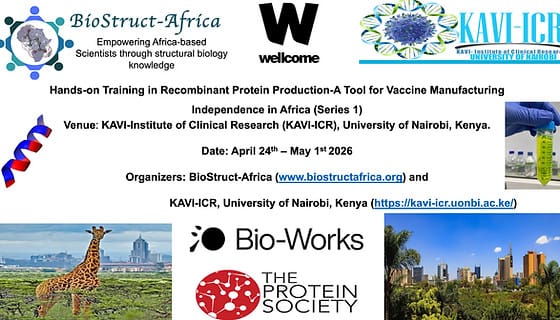
The KAVI-Institute of Clinical Research, in collaboration with BioStruct-Africa, will host a week-long hands-on training workshop focused on recombinant protein production as a strategic tool for strengthening vaccine manufacturing capacity in Africa.
The training will take place here at KAVI-ICR, the Faculty of Health Sciences at the University of Nairobi in Nairobi, Kenya, from 27 April to 2 May 2026, bringing together a selected cohort of scientists for an intensive laboratory-based learning experience.
This upcoming training comes at a critical moment for the African continent. Recent global health challenges highlighted the need for stronger regional capacity in vaccine research, development, and production. Building expertise in protein science is central to this effort, as recombinant proteins form the backbone of many modern vaccines, diagnostics, and therapeutic interventions. By strengthening these capabilities locally, African institutions can play a more active role in responding to current and future public health needs.
The workshop is designed as an immersive, practical experience that bridges theory and application. Participants will engage directly with laboratory workflows underpinning recombinant protein production, including expression, purification, and characterisation. Through guided sessions, the training emphasises not only technical competence but also an understanding of how these techniques fit into broader pipelines for vaccine development and biologics manufacturing.
This initiative reflects a shared commitment between KAVI-ICR and BioStruct-Africa to advance scientific capacity across the continent. BioStruct-Africa continues to support African researchers by integrating emerging approaches in structural biology with experimental training, while KAVI-ICR brings its extensive experience in vaccine research and clinical studies. Together, the partnership highlights the importance of collaborative, skills-based training in driving sustainable scientific progress.
As the training gets underway next week, it marks another important step toward fostering a network of scientists equipped with the expertise needed to contribute to Africa’s growing biotechnology and vaccine manufacturing landscape. The knowledge and experience gained during this program are expected to extend beyond the laboratory, supporting long-term research collaborations and strengthening institutional capacity across the region.
- Log in to post comments


