
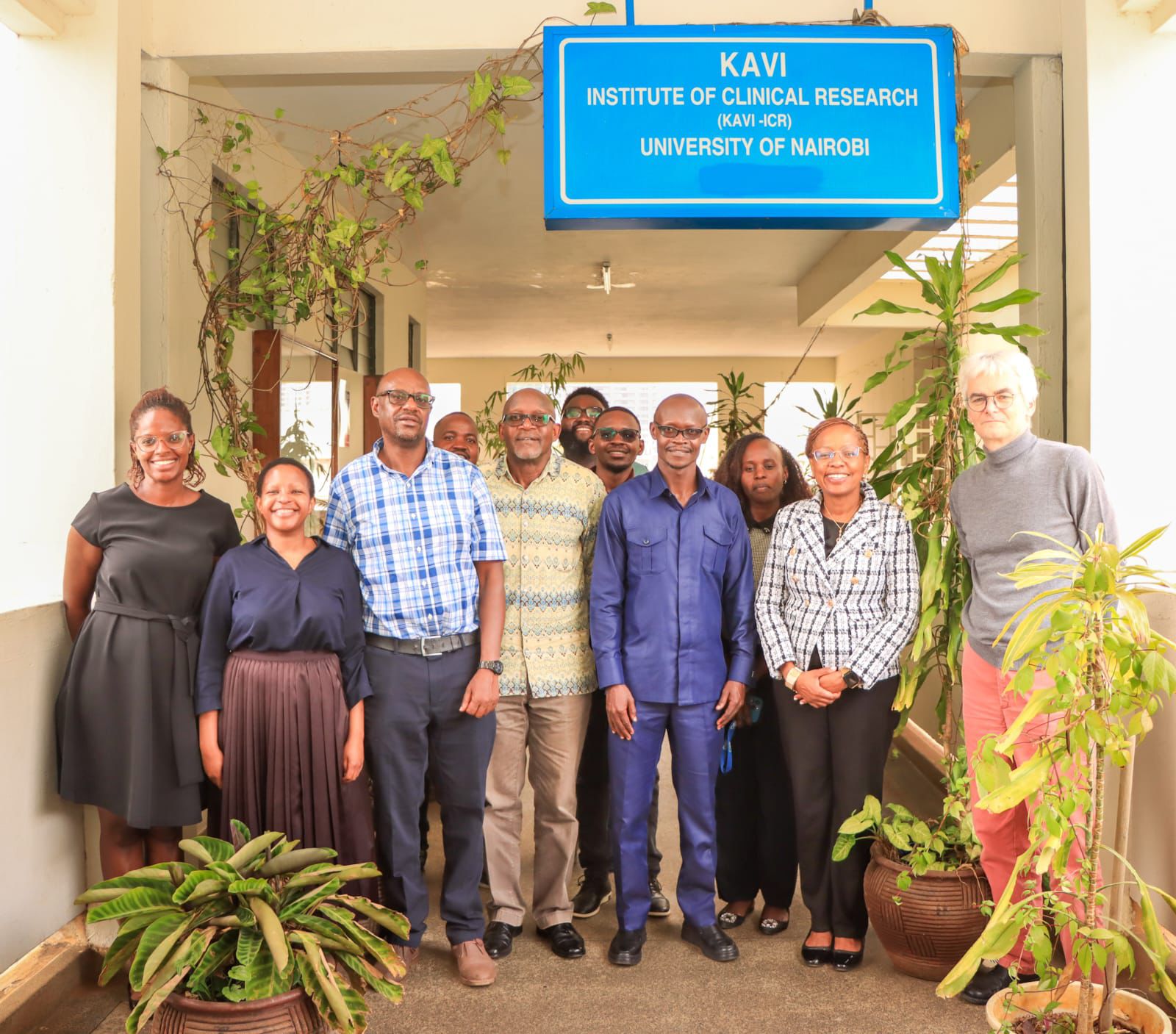
The Kenya AIDS Vaccine Initiative–Institute of Clinical Research (KAVI-ICR) recently hosted a high-level delegation from the University of Nairobi’s Advancement and Institutional Development and Engineering Science Complex Project (ESC), marking an important step in advancing innovation-driven academic–industry partnerships.
The visit brought together Prof. Marc Zolver, Chair of the ESC Project and Prof. George Abong, acting director of the UoN Advancement and Institutional Development, as well as representatives from Silk Origin Ltd, alongside KAVI-ICR leadership and scientists. Discussions focused on building translational research pathways that link cutting-edge academic expertise with real-world industrial applications.
Innovation at the Heart of KAVI-ICR’s Mission
Welcoming the delegation, Dr. Marianne W. Mureithi, Director of KAVI-Institute of Clinical Research, underscored the institute’s commitment to innovation as a driver of impact.
“At KAVI-ICR, innovation is not an abstract concept; it is a deliberate strategy,” said Dr. Mureithi. “Our mandate is to translate science into solutions that improve health and livelihoods, and that can only be achieved through strong, intentional partnerships with industry.”
She highlighted KAVI-ICR’s robust capacity in basic science, clinical trials (Phase I–IV), and One Health research, positioning the institute as a critical partner for validating the safety and efficacy of novel products emerging from university-industry collaborations.
Bridging Research and Industry for Societal Impact
The meeting explored synergies around sericulture-based innovations led by Silk Origin Ltd, including silk protein applications in biomaterials, and other products. These discussions exemplified the goals of the ESC project, to catalyse research that moves beyond the laboratory into scalable, market-ready solutions.
Prof. Omu Anzala, the first director of KAVI-ICR, emphasised the strategic importance of such collaborations:
“For research institutions like KAVI-ICR, partnerships with industry are essential to ensure our discoveries deliver tangible value to society,” Prof. Anzala noted. “Innovation thrives where academia and industry meet, and this is the model we are intentionally strengthening.”
Enabling Translational Research Through the ESC Project
During the visit, Prof. Zolver outlined the vision of the ESC Project, which prioritises funding and infrastructure for projects with strong university-industry linkages. He commended the emerging collaboration as a model for translational research that addresses real-world challenges while creating commercial and social value.
The delegation also toured KAVI-ICR’s state-of-the-art laboratories and clinics, gaining first-hand insight into the institute’s infrastructure and scientific expertise.
Looking Ahead: From Collaboration to Impact
The engagement concluded with a shared commitment to formalising partnerships and leveraging upcoming international platforms to showcase innovation arising from academic–industry collaboration. With regular coordination meetings planned, KAVI-ICR and its partners are poised to advance research that bridges science, industry, and societal need.
- Log in to post comments


