
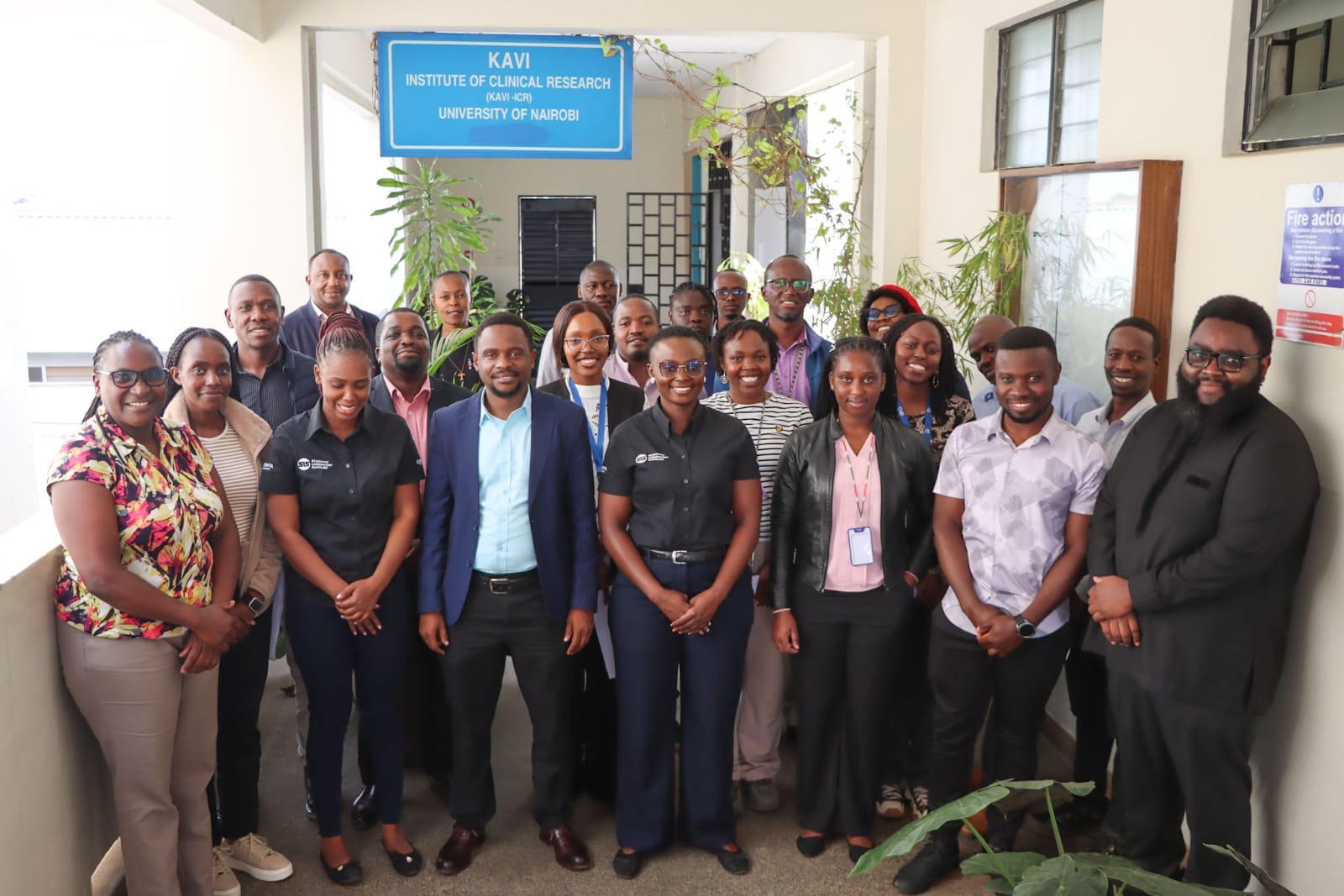
On 29 July 2026, the KAVI Institute of Clinical Research (KAVI-ICR) at the University of Nairobi hosted a ThermoFisher Innovation Day, welcoming a delegation from Scientific Laboratory Supplies (SLS) and Thermo Fisher Scientific together with scientists from Partners for Health and Development in Africa (PHDA) and the University of Nairobi's Faculty of Health Sciences. The gathering was designed as a working conversation more than just a showcase: a chance to map the laboratory technologies that are available in Kenya today, to look ahead at what is coming next, and to ask a practical question that sits at the heart of KAVI-ICR's mission — how can these tools help move discoveries from the bench to the communities who need them?
For an institute whose research spans clinical trials and experimental medicine, basic and translational science, cohort studies, and emerging infections, the answer matters. Modern immunology, genomics and proteomics increasingly depend on instruments that are fast, reproducible and accessible enough to run at scale in African laboratories. The day's presentations, delivered by SLS and Thermo Fisher specialists, worked through exactly that landscape, from the reagents and thermal cyclers already on Kenyan benches to the sequencing and proteomics platforms shaping the next decade of precision medicine.
What is available in Kenya today
Amy Wahome of Scientific Laboratory Supplies opened the day by introducing SLS as Thermo Fisher's local partner — the channel through which many of these technologies, and the service and training that go with them, reach Kenyan laboratories. That local footprint was a recurring theme: the point was not simply what exists globally, but what researchers here can actually access, support and rely on.
A broad overview of Thermo Fisher's biosciences portfolio followed, spanning the company's family of research brands, Thermo Scientific, Applied Biosystems, Invitrogen and Gibco, and the everyday molecular biology workflows they support: PCR and RT-PCR, cloning, qPCR master mixes designed to cut preparation time, protein biology and immunoassays, microplate readers and washers, and Gibco mammalian cell-culture systems. Presenters highlighted Applied Biosystems thermal cyclers whose cloud connectivity, through Thermo Fisher Connect, lets a scientist start, stop and monitor a run from a phone or laptop, a small change with real consequences for busy shared laboratories. On the genomics side, the Collibri library-preparation kits for Illumina sequencing were noted for their flexibility, including with challenging FFPE (formalin-fixed, paraffin-embedded) samples, alongside whole-transcriptome sequencing and newer electroporation tip technology for cell engineering.
The innovation pipeline: proteomics, digital PCR and rapid sequencing
Proteomics — powered by Olink. Sandra Phoma, Business Development Manager for Africa, presented Olink, the next-generation proteomics company Thermo Fisher acquired in a transaction valued at roughly US$3.1 billion. Olink's Proximity Extension Assay (PEA) technology allows scientists to measure thousands of proteins simultaneously from tiny sample volumes, with a validated library now covering more than 5,000 protein biomarker targets. The pitch to KAVI-ICR was about reach beyond genomics: an end-to-end route from biomarker discovery to translation — supported by free, web-based analysis tools and open-source R packages, and by the ability to annotate findings against large reference cohorts such as the UK Biobank and the China Kadoorie Biobank. Phoma illustrated the translational endpoint with examples where proteomic biomarkers move into real diagnostic development.
Digital PCR — absolute answers, fast. Daniel Mutua, Account Manager for East Africa in the Genetic Sciences Division, walked through advanced molecular solutions with a focus on the QuantStudio Absolute Q Digital PCR System. Built around proprietary microfluidic array plate technology, the platform collapses the traditionally multi-step, multi-instrument digital PCR workflow into a single instrument with a familiar, qPCR-like set-up and results in as little as 90 minutes. Because digital PCR delivers absolute quantification without a standard curve, it is well suited to the precise, low-abundance measurements that oncology, cell and gene therapy, and infectious-disease research increasingly demand.
Clinical next-generation sequencing — a result in a day. Duncan Maina, Technical Sales Specialist for Clinical NGS, closed the technical sessions with the Ion Torrent Genexus System, a platform that automates the journey from specimen to report and can return results in as little as 24 hours with only two user touchpoints and around 20 minutes of hands-on time. Paired with Ion AmpliSeq chemistry, it supports oncology, inherited-disease and reproductive-health applications, bringing NGS in-house for laboratories without deep bioinformatics teams. For higher-throughput work, the Ion GeneStudio S5 System, with results in roughly three days and a local Ion Reporter server option — rounds out the offering. The recurring message across both platforms was accessibility: sequencing that is fast enough, and simple enough, to inform care.
Beyond instruments: a conversation about working together
What distinguished the day was the discussion the technology prompted. Participants from KAVI-ICR, PHDA and the Faculty of Health Sciences pressed on the questions that matter most in this setting: how these platforms can be embedded in ongoing and future studies, how local service and training sustain them, and crucially, how research-grade capability can extend into diagnostics that reach patients. The through-line was a shared ambition: to shorten the distance between a discovery made in a Nairobi laboratory and a test result that changes a clinical decision.
For KAVI-ICR, that ambition is core to who we are. Since 1998, the Institute has worked to build world-class clinical research capacity in Kenya and to translate science into health impact. Engagements like the ThermoFisher Innovation Day are how that capacity keeps growing, through partnerships that pair local expertise with cutting-edge tools, and through honest conversations about how to make the newest science genuinely useful here at home.
KAVI-ICR thanks Scientific Laboratory Supplies and Thermo Fisher Scientific for a generous and stimulating day, and our colleagues from PHDA and the Faculty of Health Sciences for joining the conversation. We look forward to turning today's discussions into tomorrow's collaborations, accelerating not only research, but better diagnostics for the patients and communities we serve.
- Log in to post comments


